Resolution and speed depend on configuration. Published maxima do not imply that both can be achieved simultaneously on every substrate.
Continuous inspection
of reel printing
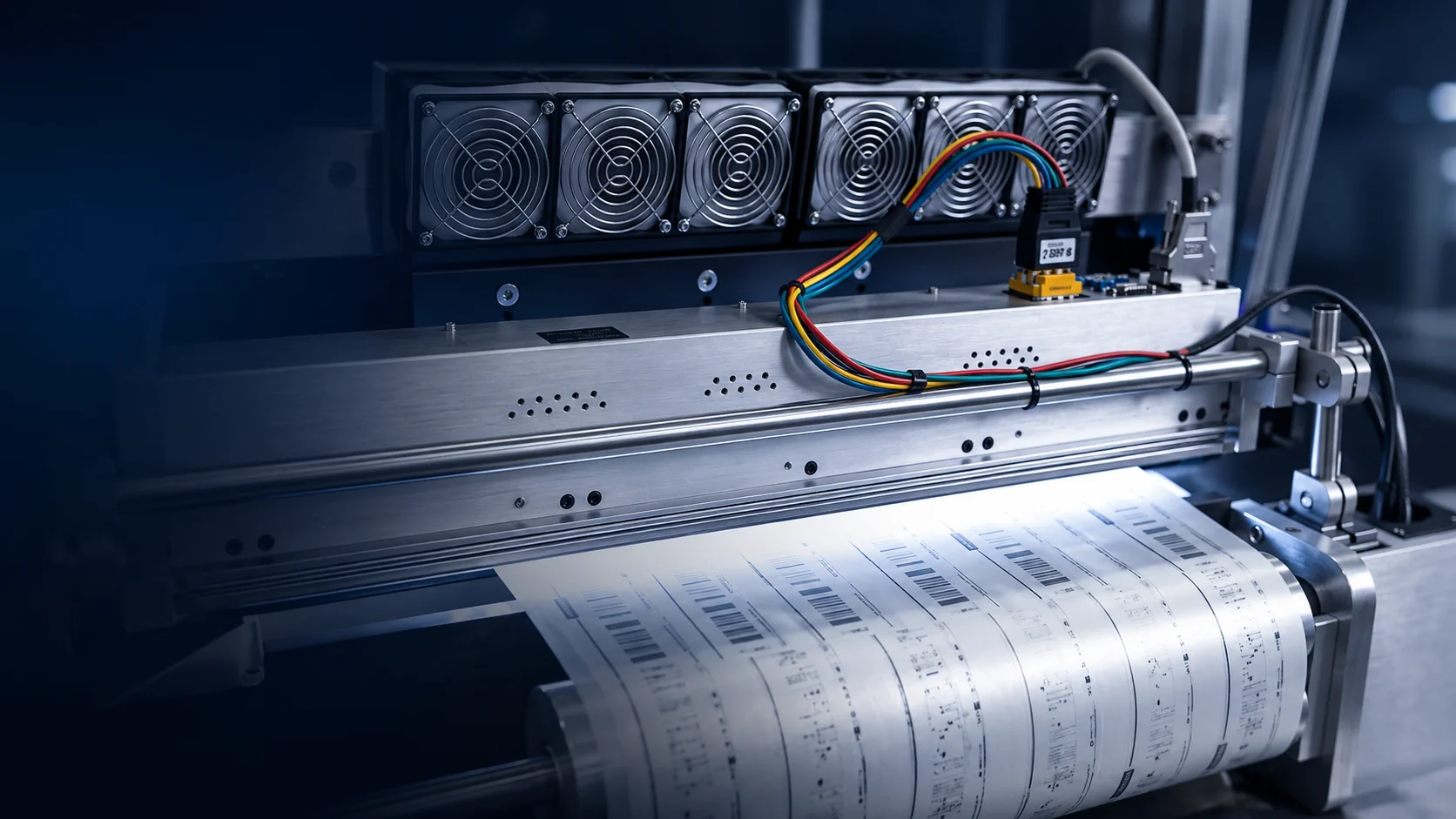
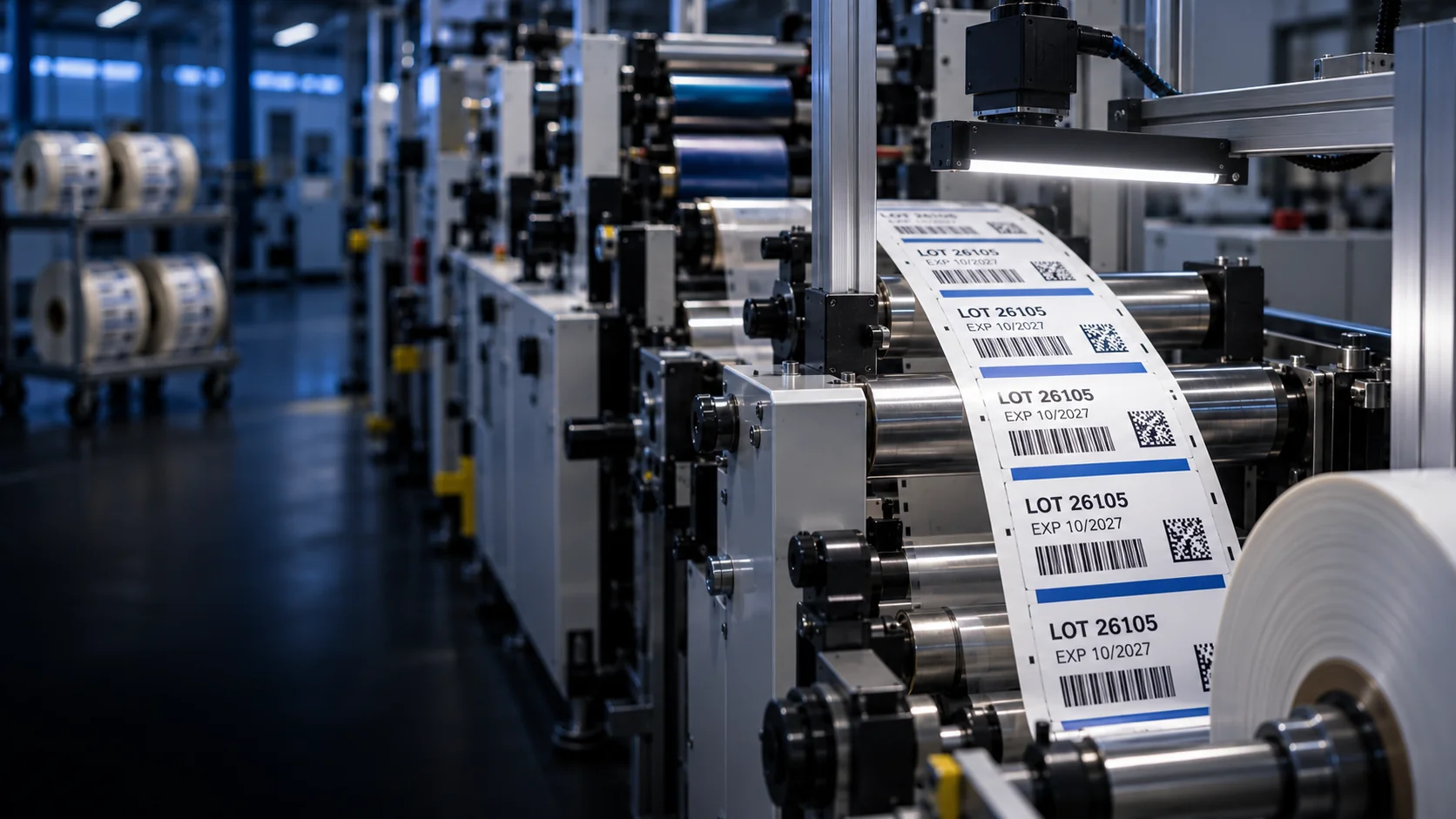
LynxLabel is a vision system built for high-speed label printing on a moving web. It sits beside lines where a single print defect, an unreadable code or a colour drift can compromise hundreds of metres of production.
It works on paper, transparent plastic, opaque plastic and aluminium, on webs of 300, 600 and 900 mm, up to 100 m/min at a resolution of up to 900 dpi. Coverage and speed depend on the project configuration.
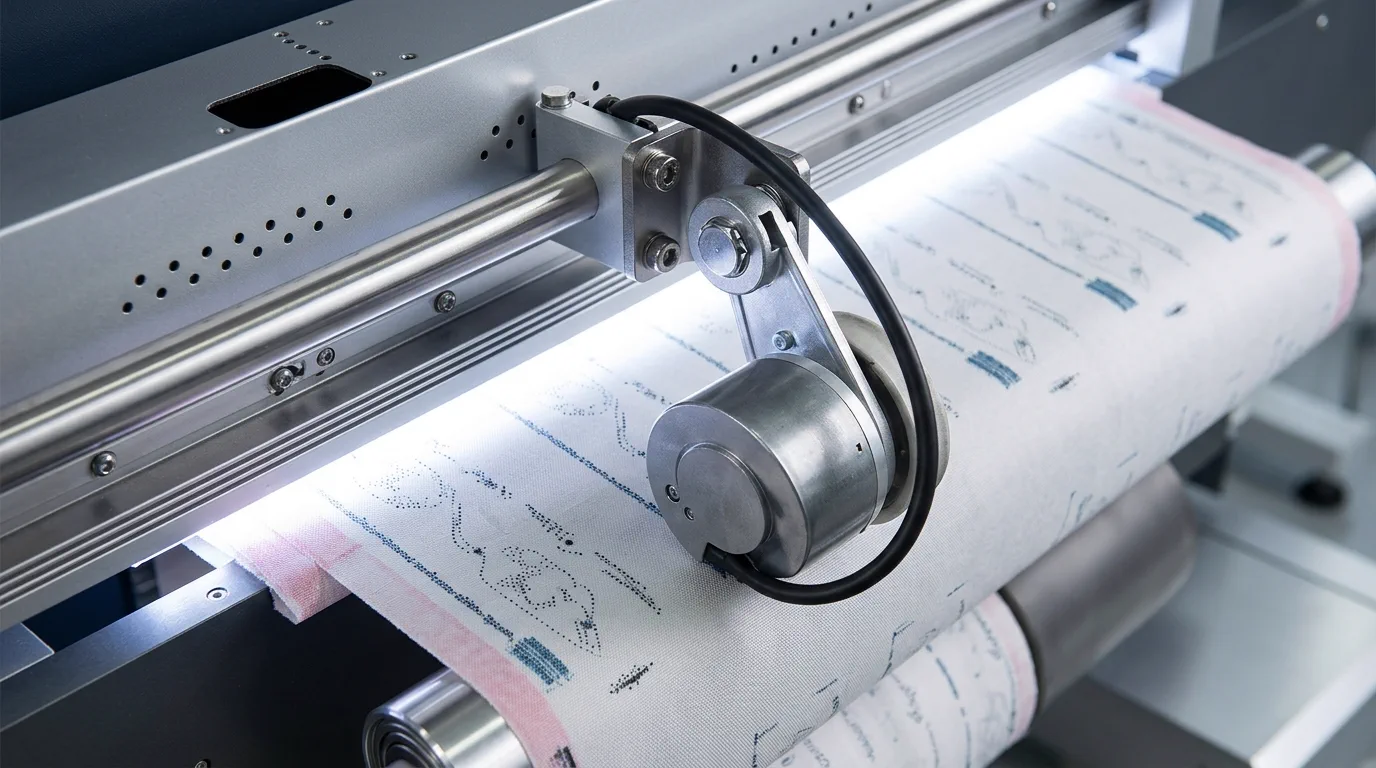
It also supports medical-grade materials, such as Tyvek.
- · Continuous acquisition across the full web width
- · Vision and artificial intelligence algorithms developed in-house by Imago
- · Installation on existing printing machines, verified for the line
- · Each detected defect recorded with image and position
Print defects,
codes and alignment
Visible defects, subtle anomalies, out-of-spec codes. LynxLabel flags and classifies them during printing, according to the configured criteria.
Ink stains
Detection of smudges, droplets and contamination, with limits validated for the substrate and imaging configuration.
Missing ink
Identification of graphic elements missing or partially printed compared to the reference master.
Colour shift
Continuous colour monitoring to catch ink depletion or head malfunctions before they cause waste.
Head misalignment
Verification of overlay across multi-pass prints, with early warning on mechanical drift.
Nozzle clogging
Early diagnosis of partially or fully clogged nozzles, before the defect becomes systematic.
Continuous streaks
Detection of vertical lines caused by a single faulty nozzle, even when they are hard to see with the naked eye.
1D & 2D codes
Reading, decoding and quality grading of linear barcodes, DataMatrix, QR and composite codes to ISO/IEC 15415 and 15416.
Notch pitch
Verification of pitch between reference notches to check that the web advances correctly to downstream processes.
Print centring
Control of print position relative to the substrate, with warnings on horizontal and vertical drift.
Hole inspection
Verification of presence, size and position of pinfeed holes and other functional perforations.
OCR · Character reading
Recognition and reading of variable printed text: batches, expiry dates, serial numbers, custom keywords.
OCV · Character verification
Pixel-by-pixel comparison of printed text against the expected model. Characters outside the configured criteria are flagged.
Where print
identifies the product
LynxLabel is already installed on lines where print quality is a market requirement, a supply-chain need or a legal obligation.
Pharma labels
Check batch numbers, expiry dates, codes and specified label text. Applicable requirements and traceability data are defined for the project.
Food & beverage
Check barcodes, nutrition tables and ingredients against a reference, using acceptance criteria defined for the label.
Logistics & traceability
Reading and grading of barcodes, GS1-128 and DataMatrix. Results support reject handling on the line.
Cosmetics & perfumery
Premium printing on textured paper and transparent plastic, with very tight colour and registration tolerances.
Security labels
Unique codes, micro-text and anti-counterfeit markers , checked continuously on the reel rather than by sampling.
Custom lines
Industrial labels, energy, automotive, electronics: every check is configurable for the specifics of each customer.
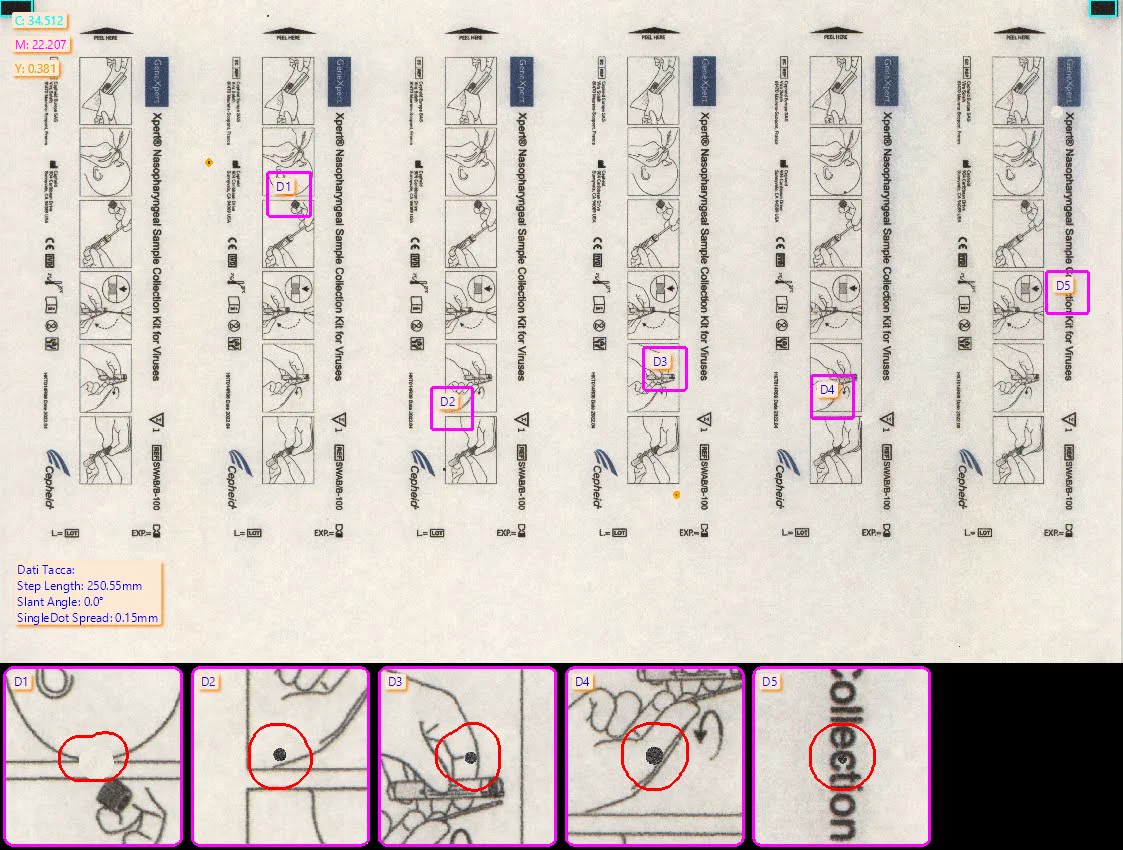
From a print defect
to its position on the web
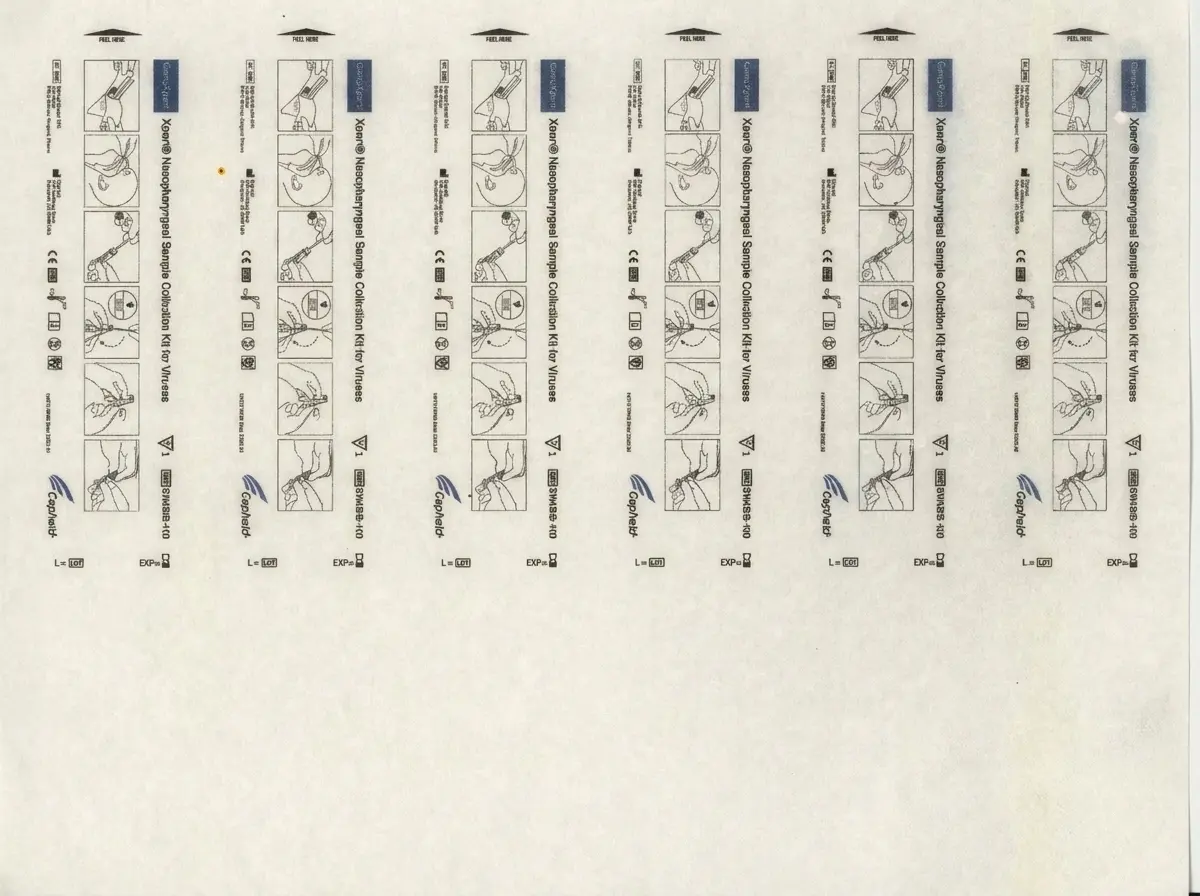
Compare the acquired image with the annotated analysis and enlarged defect details.
Software for the people running the line
The operator sees what they need: the status of every check, the defects detected, the history, the production statistics. Configuration functions remain with authorised profiles.
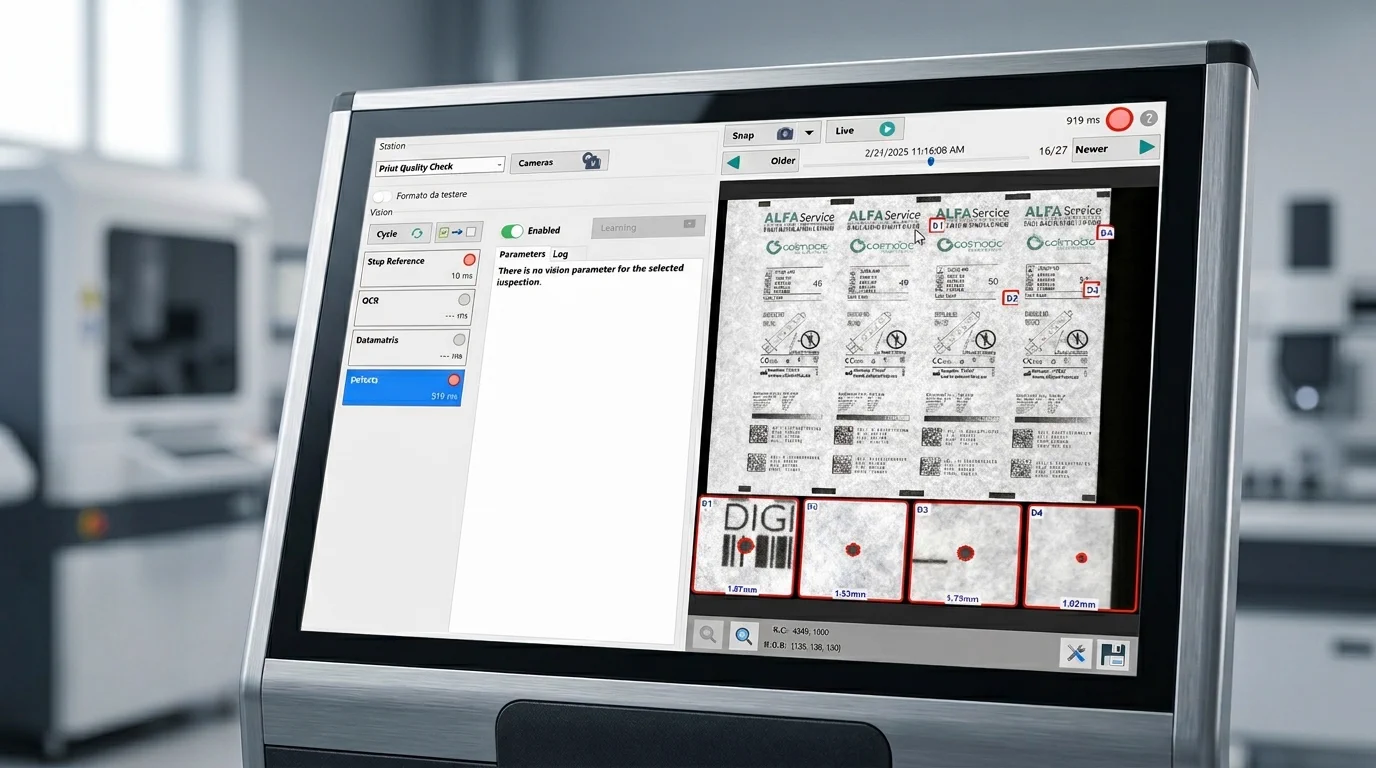
Functions for production and quality
- Multi-window live view — real-time view of every inspection channel.
- Recipe-based configuration — one job per label, callable from HMI or external signal.
- Defect history — every flag is archived with image, timestamp and defect class.
- Production statistics — rejects, acceptance rates and trends by shift.
- Multi-user access — differentiated profiles for operator, supervisor and technician.
- MES/ERP integration — standard data export (CSV, JSON), HTTP API, OPC UA.
- Remote support — diagnostics, support and updates through agreed remote access.
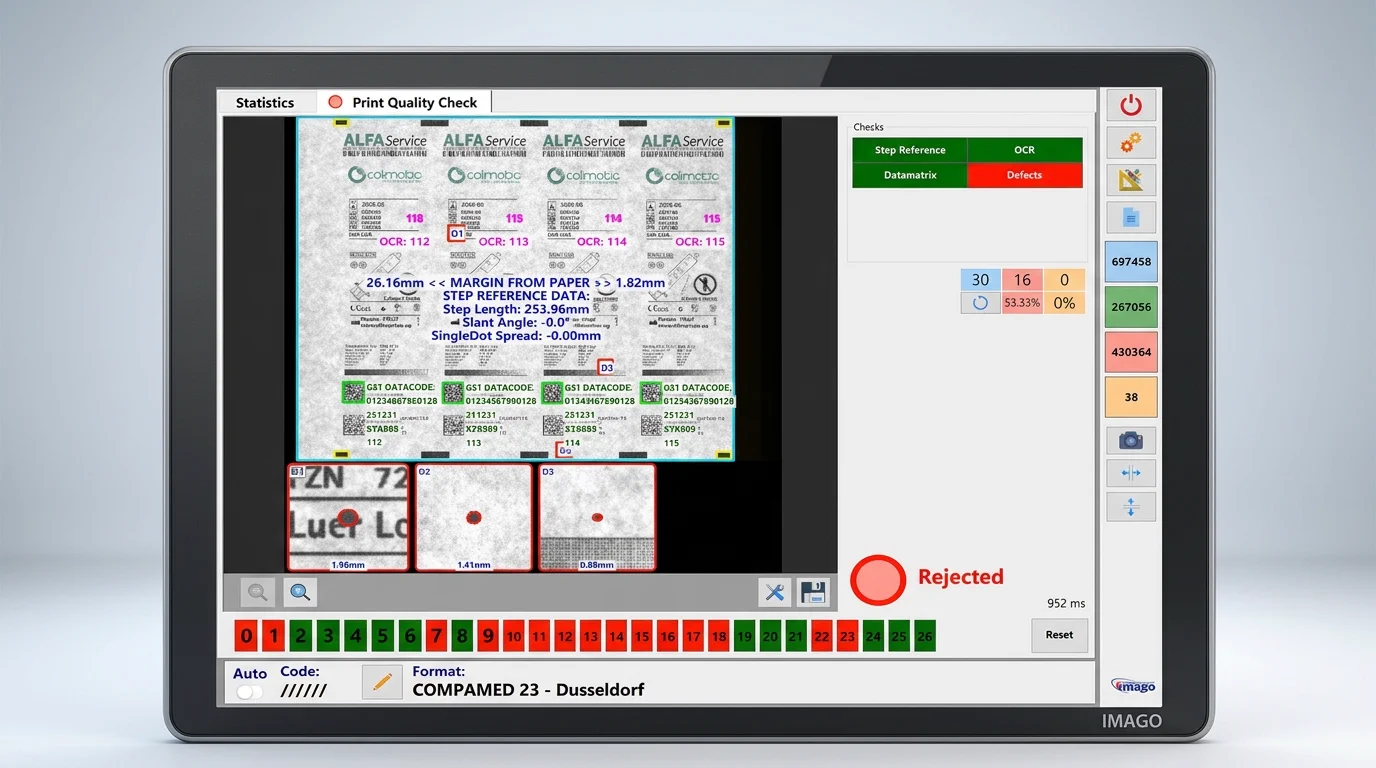
Defects up front, conformity in the background
- Automatic annotation — every defect is highlighted on the image and detailed alongside.
- Measurements in mm — dimensions of detected defects, according to the imaging configuration.
- Adjustable thresholds — the operator sets rejection criteria according to assigned permissions.
- Aggregated outcomes — at a glance, you know whether production is on spec.
Specifications for the production line
Resolution is configurable depending on substrate and speed; the combination of web width, speed and checks is defined for the project.
Frequently asked questions
Which print substrates does LynxLabel work on?
LynxLabel inspects labels printed on paper, transparent plastic, opaque plastic and aluminium. It also supports medical-grade materials such as Tyvek. Lighting configurations adapt to the substrate to obtain suitable contrast even on highly reflective or semi-transparent film.
Does it integrate with existing printing machines?
Yes. The system is designed as an inspection module to be installed in-line on existing presses (flexographic, digital, offset) with no invasive mechanical changes. Integration with the machine PLC is via digital I/O, Ethernet/IP, Profinet or OPC UA.
How long does installation take?
Typically 1–2 days. Imago technicians follow commissioning, calibration and operator training on-site, and set up the initial recipes for the main label formats together with the customer.
How quickly can a new recipe be created?
A new recipe takes on average 5–10 minutes starting from a new label. Once saved, it can be recalled in moments from the HMI or from an external signal (format change on the PLC).
What does LynxLabel check?
Ink stains, missing ink, colour shift, head misalignment, nozzle clogging, continuous streaks from a single nozzle, reading and grading of 1D and 2D codes, OCR, OCV, hole presence and size, print centring, correct notch pitch.
What line speed can it sustain?
LynxLabel runs at up to 100 m/min, inspecting labels continuously, on web widths of 300, 600 or 900 mm with resolution configurable up to 900 dpi.
How are inspection data stored?
Every flag is stored with image, timestamp, position on the web and defect class. Data can be exported as CSV/JSON, queried via HTTP API or OPC UA, and integrated with the plant MES/ERP.
Is an internet connection required?
No. LynxLabel runs fully offline inside the plant network. Internet is only needed for software updates and remote support — both optional and handled via secure VPN.
What maintenance does it need?
Minimal: monthly cleaning of the optical and lighting modules with a soft cloth and isopropyl alcohol. Optics are protected by dedicated housings.
What support services do you offer?
Imago has a dedicated technical support team, active during Italian business hours, with dedicated remote assistance. We operate with two partner companies worldwide — one in the United States and one in the Czech Republic.
Installation and recipe creation times, integrations and applicable requirements are confirmed for the agreed configuration.
Print & labels
Show us your label. We'll show you what it checks
Tell us about the substrate, line speed and the checks you need. The Imago team will evaluate your application.
Let’s talk about your label